
Overview
Everything you need to know about using ChainHint for blockchain forensics and crypto incident response.
How It Works
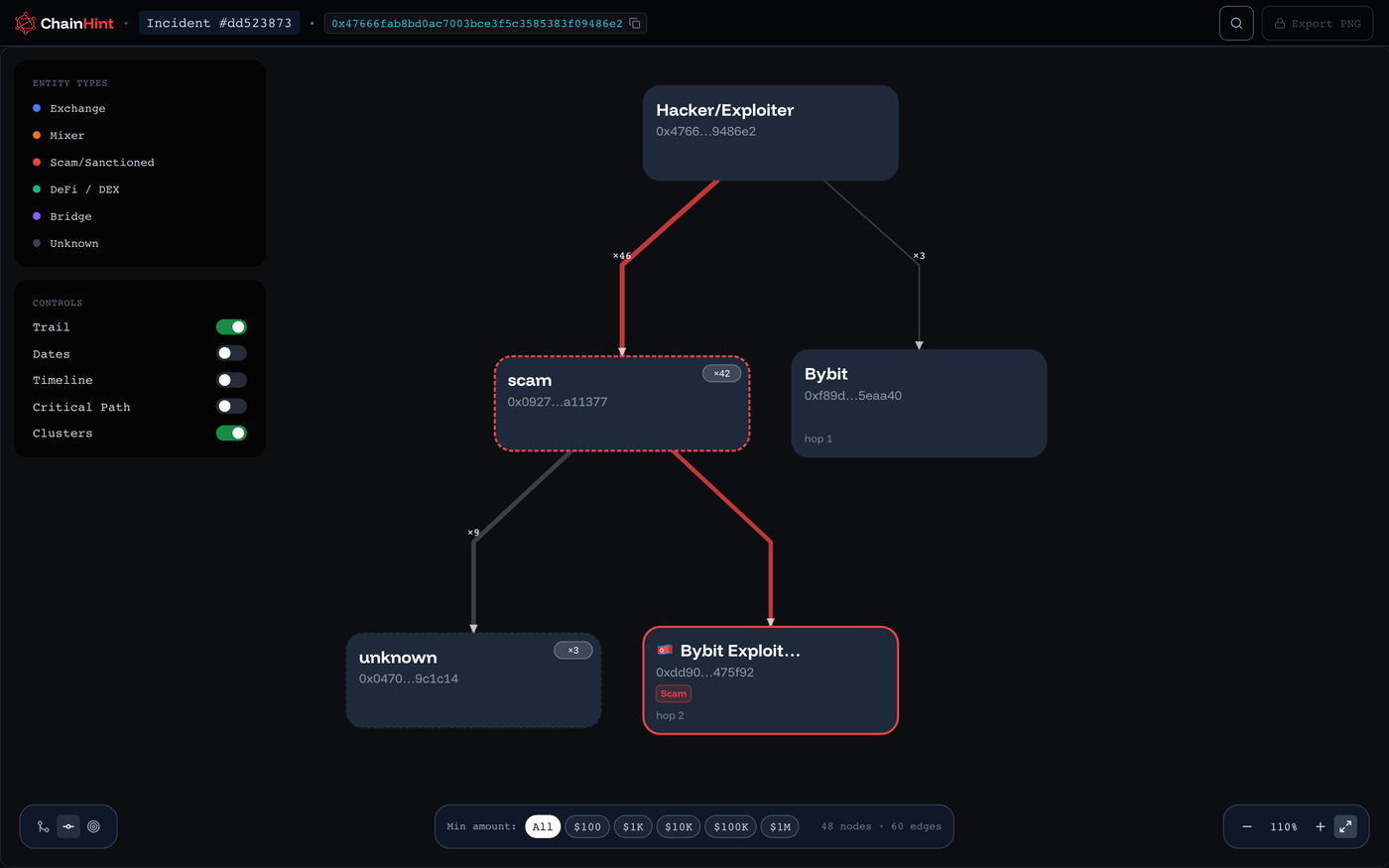
ChainHint traces cryptocurrency funds using a Breadth-First Search (BFS) algorithm starting from a suspect address. At each hop, it fetches on-chain transactions, identifies counterparties, looks them up in the entity database, and scores them for risk.
Fund Trace Pipeline
Address Input
Paste any ETH, BTC, Solana, or Tron address. ChainHint validates the chain and normalizes the format.
BFS Traversal
Transactions are fetched hop by hop. Each hop expands to counterparty addresses, pruning at exchanges and known endpoints.
Entity Attribution
Every address is matched against 48M+ attributed addresses — identifying exchanges, mixers, bridges, and sanctioned wallets.
Hop Limits by Plan
| Plan | Max Hops | Addresses / Trace |
|---|---|---|
| Free | 3 hops | 50 |
| Investigator | 4 hops | 500 |
| Agency | 6 hops | 2,000 |
Investigation Chaining
From any node in the graph, click Investigate → to launch a new trace starting from that address. Breadcrumb navigation (A → B → C) tracks the chain of investigations. Each child investigation bypasses the deduplication check so you can explore freely.
Browse the docs
Fund Tracing
How ChainHint traces crypto funds — transaction action types, cross-chain bridge detection, and the 12 supported blockchains.
Incident Analysis
How an attacker's address becomes a forensics report: trace depth by plan, the AI report, MITRE ATT&CK attack types, loss pricing, freeze packet.
Risk Scoring
How ChainHint scores every address from 0 to 100 — risk levels, signals, weights, and the sources behind each flag.
Source of Funds
See who funded any wallet — named senders with USD amounts, entity labels, and risk categories across Ethereum, TRON, Bitcoin, Solana and more.
Monitoring
Track addresses with the watchlist and see where stolen funds move in aggregate on the velocity dashboard.
Entity Database
48M+ attributed addresses across 12 chains — sources, categories, and data attributions.
Compliance
Screen a counterparty by name against the EU, UK and US sanctions lists we hold, and export compliance-ready PDF reports with the fund trace.
API & MCP
Query wallet risk programmatically via the Wallet Reputation API and the ChainHint MCP server for AI workflows.
FAQ
Frequently asked questions about ChainHint — supported chains, accuracy, loss calculation, privacy, payments, and more.